Build instructions
Source code
The source code for the reference designs is managed on this Github repository:
Note that the repository contains submodules, so it is essential to use the --recursive option when cloning:
git clone --recursive https://github.com/fpgadeveloper/zynqmp-hailo-ai.git
License requirements
The designs for all of the target boards can be built with the Vivado ML Standard Edition without a license.
Target designs
This repo contains several designs that target the various supported development boards and their FMC connectors. The table below lists the target design name, the camera ports supported by the design and the FMC connector on which to connect the RPi Camera FMC.
Note that there are two target designs for the ZCU106 board: zcu106 and zcu106_hpc0, and the
differences are explained in the table below.
All target designs except zcu106 require the M.2 M-key Stack FMC as the M.2 adapter for the Hailo-8, with the
RPi Camera FMC stacked on top of it.
Zynq UltraScale+ designs
Target board |
Target design |
Cameras |
M.2 |
FMC Slot |
VCU |
Stack Design |
Vivado |
|---|---|---|---|---|---|---|---|
|
4 |
1 |
LPC |
✅ |
✅ |
Standard 🆓 |
|
|
4 |
1 |
HPC0+HPC1 |
✅ |
❌ |
Standard 🆓 |
|
|
4 |
2 |
HPC0 |
✅ |
✅ |
Standard 🆓 |
|
|
2 |
1 |
LPC |
❌ |
✅ |
Standard 🆓 |
|
|
4 |
2 |
HPC |
✅ |
✅ |
Standard 🆓 |
Notes:
The Vivado Edition column indicates which designs are supported by the Vivado Standard Edition, the FREE edition which can be used without a license. Vivado Enterprise Edition requires a license however a 30-day evaluation license is available from the AMD Xilinx Licensing site.
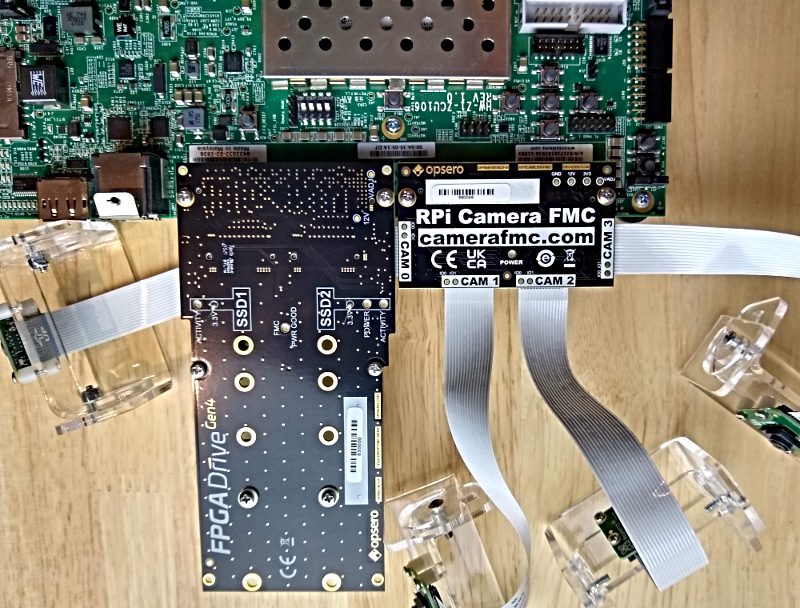
The Stack Designs use the M.2 M-key Stack FMC with the RPi Camera FMC stacked on top of it. The non-stack designs use the FPGA Drive FMC Gen4 on one FMC connector, and the RPi Camera FMC on another.
The
zcu106target design uses the FPGA Drive FMC Gen4 as the M.2 adapter for the Hailo-8. In that design, the FPGA Drive FMC Gen4 connects to HPC1 while the RPi Camera FMC connects to the HPC0 connector.The
pynqzuandgenesyszutarget designs have video pipelines for only 2 cameras (CAM1 and CAM2 as labelled on the RPi Camera FMC). This is due to the resource limitations of the devices on these boards.The
zcu106_hpc0anduzevtarget designs have support for 2x M.2 modules. To use the Hailo demo scripts, at least one of these modules must be the [Hailo-8 M.2 AI Acceleration Module]. The second slot can be used for a second Hailo module, or an NVMe SSD for storage.
Stack designs
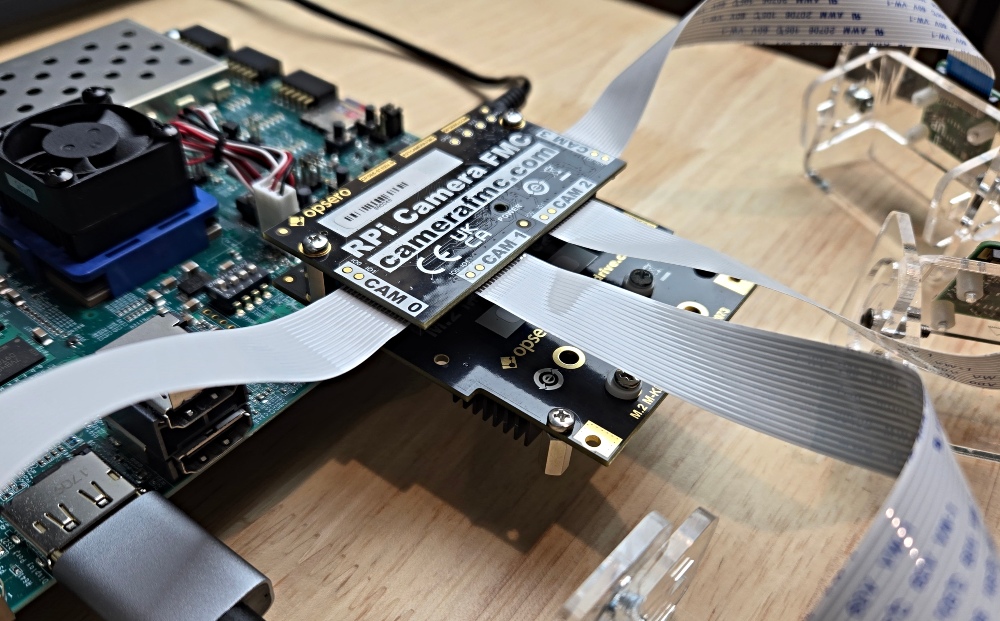
The “stack” designs are intended to be used with the RPi Camera FMC stacked on top of the M.2 M-key Stack FMC as shown in the image below. This setup allows both the RPi Camera FMC and the M.2 adapter to be connected to the carrier board through a single FMC connector.
Non-stack design
The single non-stack design for ZCU106 (target design zcu106) is intended to be used with the RPi Camera FMC on connector HPC0 and
the FPGA Drive FMC Gen4 on connector HPC1 as shown in the image below.
Linux only
These projects can be built using a machine (either physical or virtual) with one of the supported Linux distributions.
Tip
The build steps can be completed in the order shown below, or you can go directly to the build PetaLinux instructions below to build the Vivado and PetaLinux projects with a single command.
Build Vivado project
Open a command terminal and launch the setup script for Vivado:
source <path-to-vivado-install>/2024.1/settings64.sh
Clone the Git repository and
cdinto theVivadofolder of the repo:git clone --recursive https://github.com/fpgadeveloper/zynqmp-hailo-ai.git cd zynqmp-hailo-ai/Vivado
Run make to create the Vivado project for the target board. You must replace
<target>with a valid target (alternatively, skip to step 5):make project TARGET=<target>
Valid target labels are:
zcu104,zcu106,zcu106_hpc0,pynqzu,uzev. That will create the Vivado project and block design without generating a bitstream or exporting to XSA.Open the generated project in the Vivado GUI and click Generate Bitstream. Once the build is complete, select File->Export->Export Hardware and be sure to tick Include bitstream and use the default name and location for the XSA file.
Alternatively, you can create the Vivado project, generate the bitstream and export to XSA (steps 3 and 4), all from a single command:
make xsa TARGET=<target>
Build PetaLinux project
These steps will build the PetaLinux project for the target design. You are not required to have built the Vivado design before following these steps, as the Makefile triggers the Vivado build for the corresponding design if it has not already been done.
Launch the setup script for Vivado (only if you skipped the Vivado build steps above):
source <path-to-vivado-install>/2024.1/settings64.sh
Launch PetaLinux by sourcing the
settings.shbash script, eg:source <path-to-petalinux-install>/2024.1/settings.sh
Build the PetaLinux project for your specific target platform by running the following command, replacing
<target>with a valid value from below:cd PetaLinux make petalinux TARGET=<target>
Valid target labels for PetaLinux projects are:
zcu104,zcu106,zcu106_hpc0,pynqzu,uzev. Note that if you skipped the Vivado build steps above, the Makefile will first generate and build the Vivado project, and then build the PetaLinux project.
Build issue and workaround
When building the PetaLinux project, you might experience one or more of the following error messages:
ERROR: hailortcli-4.19.0-r0 do_configure: ExecutionError('/home/user/zynqmp-hailo-ai/PetaLinux/zcu106/build/tmp/work/cortexa72-cortexa53-xilinx-linux/hailortcli/4.19.0-r0/temp/run.do_configure.2849196', 1, None, None)
ERROR: Logfile of failure stored in: /home/user/zynqmp-hailo-ai/PetaLinux/zcu106/build/tmp/work/cortexa72-cortexa53-xilinx-linux/hailortcli/4.19.0-r0/temp/log.do_configure.2849196
ERROR: Task (/home/user/zynqmp-hailo-ai/PetaLinux/zcu106/project-spec/meta-user/meta-hailo/meta-hailo-libhailort/recipes-hailo/hailortcli/hailortcli_4.19.0.bb:do_configure) failed with exit code '1'
ERROR: libhailort-4.19.0-r0 do_configure: ExecutionError('/home/user/zynqmp-hailo-ai/PetaLinux/zcu106/build/tmp/work/cortexa72-cortexa53-xilinx-linux/libhailort/4.19.0-r0/temp/run.do_configure.2851680', 1, None, None)
ERROR: Logfile of failure stored in: /home/user/zynqmp-hailo-ai/PetaLinux/zcu106/build/tmp/work/cortexa72-cortexa53-xilinx-linux/libhailort/4.19.0-r0/temp/log.do_configure.2851680
ERROR: Task (/home/user/zynqmp-hailo-ai/PetaLinux/zcu106/project-spec/meta-user/meta-hailo/meta-hailo-libhailort/recipes-hailo/libhailort/libhailort_4.19.0.bb:do_configure) failed with exit code '1'
If you open one of the logfiles of those error messages, you will find error messages that are similar to the following:
Cloning into 'protobuf-src'...
fatal: unable to access 'https://github.com/protocolbuffers/protobuf.git/': error setting certificate file: /usr/local/oe-sdk-hardcoded-buildpath/sysroots/x86_64-petalinux-linux/etc/ssl/certs/ca-certificates.crt
Explanation:
In order to build the meta-hailo recipes, PetaLinux needs to clone some repositories. To do this, it requires
a digital certificate that is expecting to find in path /usr/local/oe-sdk-hardcoded-buildpath/sysroots/x86_64-petalinux-linux/etc/ssl/certs/.
The correct location of the certificate is /<petalinux-install-path>/2024.1/sysroots/x86_64-petalinux-linux/etc/ssl/certs/.
Work-around:
As a work-around to this issue, we suggest creating a symbolic link so that PetaLinux finds the digital certificate where it is expecting to find it.
sudo mkdir -p /usr/local/oe-sdk-hardcoded-buildpath/sysroots/x86_64-petalinux-linux/etc/ssl/certs/
sudo ln -s /<petalinux-install-path>/2024.1/sysroots/x86_64-petalinux-linux/etc/ssl/certs/ca-certificates.crt /usr/local/oe-sdk-hardcoded-buildpath/sysroots/x86_64-petalinux-linux/etc/ssl/certs/ca-certificates.crt
Note that before running the commands, you must replace <petalinux-install-path> with the correct path to your PetaLinux
installation. After running the above commands, delete the failed PetaLinux project (eg. cd PetaLinux & rm -rf pynqzu) and re-run make.
PetaLinux offline build
If you need to build the PetaLinux projects offline (without an internet connection), you can follow these instructions.
Download the sstate-cache artefacts from the Xilinx downloads site (the same page where you downloaded PetaLinux tools). There are four of them:
aarch64 sstate-cache (for ZynqMP designs)
arm sstate-cache (for Zynq designs)
microblaze sstate-cache (for Microblaze designs)
Downloads (for all designs)
Extract the contents of those files to a single location on your hard drive, for this example we’ll say
/home/user/petalinux-sstate. That should leave you with the following directory structure:/home/user/petalinux-sstate +--- aarch64 +--- arm +--- downloads +--- microblaze
Create a text file called
offline.txtin thePetaLinuxdirectory of the project repository. The file should contain a single line of text specifying the path where you extracted the sstate-cache files. In this example, the contents of the file would be:/home/user/petalinux-sstate
It is important that the file contain only one line and that the path is written with NO TRAILING FORWARD SLASH.
Now when you use make to build the PetaLinux projects, they will be configured for offline build.